Wednesday, May 20, 2015

Restorative Yoga on a Budget - Cat Not Included


Restorative yoga is a wonderful way to rest, recuperate, gently stretch tight areas of the body, and to let the "thinking brain" slow down while we dissolve into relaxation.  An important part of the relaxation response is to feel comfortable and safe.  The yoga industry has created many props and tools to aid in comfort, and I own most of them!  However, we needn't make our wallets uncomfortable in order to be comfortable during class.  Here are some of the props you might commonly find in a restorative yoga class, and how you can use available items from home or the gym to make yourself comfortable.  Special thanks to our cat, Oreo, for modeling some of the equipment.  Cat is not required for restorative practice.


MAT

One of the most common elements in class is a yoga mat.  These can range anywhere from $10 to over $100.  My first mat was a $20 mat that lasted for four years, so good mats can be found cheaply. If you don't have a mat, at the facility where I'm teaching restorative yoga, Boom Fitness Tanasbourne, you may use one of the yoga mats in the group-ex room or line up two of the shorter but thicker black mats.  Even if you have your own yoga mat, softening it with two black mats underneath might enhance your comfort level.

Mat-recycling tip - when a mat starts feeling "old" to you (for me, it's when enough of the top surface rubs off that I feel like my feet will slide), don't throw it out.  You can set it below your newer mat to add more cushion between your body and the floor.  You could also roll it up and secure it with rubber bands to make your own soft foam roller or bolster (see below).

BLOCKS

A standard yoga block is 4 inches by 6 inches by 9 inches and is tucked under knees, hips, arms, and any other places that can't reach the ground while you're trying to relax.  Ideally, you will be fully supported by a block, a towel, a rolled-up mat, or the floor in every part of your body so you can relax.  Boom has standard yoga blocks, so you may use what's available at the gym.  If you want a softer, more shape-conforming block (especially for back bends), there are fancy rounded blocks called "Namasteggs," which are quite comfy.  Also, the purple block shown is twice the size of a regular block.  If you have difficulty sitting on the floor, this block might be useful to you.  Just keep in mind that extra blocks are an option, not a requirement, for class.


BOLSTERS

Many of the poses in restorative yoga are done on our backs, and some of the poses are even more effective if the head, shoulders, and chest are raised so that the arms can relax at a lower height than the torso.  The softest and most comfortable way to do this is on a yoga bolster (see the black cushion in the second photo below).  Think of a yoga bolster as a tightly stuffed sofa cushion a little shorter than a foam roller.  They are very comfortable to recline upon, but they're not commonly found in our homes or gyms.  Here are some alternatives.  Most gyms have foam rollers, and that's what we'll be using during my classes at Boom.  When you compare the feel of a foam roller to the feel of a bolster, the foam rollers can feel hard and unyielding, making it hard to get comfortable.  Fear not!  There's an easy way to make a hard foam roller soft - simply cushion it with a towel.  If that's still too high or feels too stiff for you, folding two towels longwise and stacking them will also aid in comfort.


Here's an example of how to set up for a very common reclining pose, reclined bound angle pose, with "typical" yoga equipment and with two towels.


The bolster set-up with 5 Namasteggs to raise it and to support under the thighs will get you higher up, and it will be very comfortable; it will also cost you a little over $100.  Stacking a few towels, even if you have to buy them, would be much, much cheaper (and there are already blocks at Boom).

So, you might think you need all of this to relax.


But really, you might just need this.


No cats were harmed in the writing of this blog post.  She simply follows me everywhere when I'm home, so I didn't shoo her out of the pictures when her front end was facing the camera.

Namaste, and much relaxation to you.


Sunday, May 17, 2015

What Fitness Format(s) Should You Teach? Ideas for making a decision

Introduction and credit where credit is due:

One of the questions I've seen arise on several fitness forums that I frequent is, "What format should I teach next?"  I'm writing this article for my more practical friends who want to take the courses that will be the most salient, relevant, joyous and profitable for them.

My main inspiration is from two sources.  The first source is Chalene Johnson, who gave two lectures at the IDEA World Fitness Convention in 2008 about how to be a rock star instructor.  The inspiration behind her words has lingered with me for years - develop a fitness mission that matters to you and seek a client demographic who matters to you - and has shaped many of my career decisions for the better.  The second source is Kristin Benton, whose blog article on choosing the right fitness format intrigued me enough that I felt compelled to write my own laundry list and credit hers!  Here is Kristin's Article on choosing a fitness format

Where to start?  What's out there?  

When I see people post, "What should I teach next?" on social media, the inevitable result is dozens of posts with the names of currently popular brand-name formats and many, many exclamation points, emoticons and hearts.  This is a helpful start because it gives us a bit of a pulse for what's out there, and which formats are marketing heavily.  That's a good thing.  When an instructor is passionate about a format, there's no reason they shouldn't shout it out to the world.  However, there are fabulous formats that aren't heavily marketed, either because they're new, they're small, they don't have a huge marketing budget, or their inventor isn't trying to go global.  Further, many instructors who have group-ex certifications design their own formats and don't market them at all.

This is why I love playing fitness detective - finding the hidden gems and then tweaking them to fit my own clients' goals. If you want to learn about what else is out there in the fitness community that's non-branded or quietly marketed, here are some ways to get information that's more in-depth or more relevant.  Instead of posting, "What format should I teach?" I post something more akin to...


  1. What are the 5 most successful formats at the club where you work?  If they're not brand name classes, please tell me a little bit about the formats.
  2. What are a couple of the formats you've seen that are the best for (insert your target demographic here).  If they're not brand name classes, please tell me a little about the format.
  3. Have you ever taught classes for (insert target demographic here)?  What kinds of things did you include to make them successful?
  4. If you've ever launched a new format at your club and kept it going successfully for more than a year, what kind of format is it, and did you design it yourself or is it a format I can get certified in?

That's too much work.  I'd rather teach a branded format.

That's cool.  Here are some things to consider when exploring possible brands.  There are huge differences in fee structures, license requirements, continuing education, and creative freedom, so it may behoove you to ask about these items up front.  A few of these items are from Kristin's list (linked above).

Questions about the format itself.  

How much does the training cost?

After the training, what additional costs are involved - monthly membership dues, annual re-licensing, music, equipment, etc.  Are those fees optional or required?

If there is an optional monthly club, membership, pro team etc., what are my rights to teach the format if I don't join, and can I successfully launch and teach the format if I don't join?

Is the format 100% pre-choreographed, partially choreographed, or does the instructor design their own workouts using the main principles of the format?

If the format is pre-choreographed, how much leeway is there to stray from their choroegraphy, i.e. are there options for differing levels of ability or modifications for injury?

Does the course offer CECs from major providers like ACE, AFAA, or ACSM?

Am I required to hold a group exercise certification in order to teach the format?  If so, does the format itself design workouts that are consistent with the theories, principles, and contraindications of that group exercise certification (my personal pet peeve)?

Is there an exam, video, or other quality control feature in order to teach the format?  What about after I've received my training - are there quality control standards for continuing instructors?

What kind of trainer support will I get from the company?

What kind of instructor - to - instructor network is available for me?  How active is it in general?  How active is it in my area?  Meet-ups, practice sessions, conferences, masterclasses....?

When I correspond with the company, how responsive are they? Are they eager to help?

What, if any, costs are associated with cancelling my membership?

What marketing support is provided for the format?

Will I be encouraged to sell any products that parallel the format?  Does this opportunity interest me?

Questions about myself and my area.

Is this a format that I'm personally passionate about and feel like I would enjoy teaching?

Will my current clients be interested in this, or is this a format where I will need to expand my clientele in order to succeed?  If this is new territory for me and I need to attract a different type of client, am I willing and excited to do this?

Am I already good at this?  Am I willing to put the time into being good at this?  What skills / talents / attributes do I not yet have that will make me sellable in this format?

Do the company's ethics match mine?

Do I prefer to be the first to market, blazing a trail with a new format, or would I rather launch something that's tried and true?

Brand recognition - do people know about this format in my area?  And if so, what's the format's reputation in my area?  Is it consistent with my own reputation?

Market saturation - popular enough to be able to get a job and get subs, but not over-saturated.

How much prep time will it take me to prepare for my first class, and how much prep time will be involved in future classes?

Do I know any of the instructors in the area?  Would I want to network or collaborate with them?

What does my gut say?

Friday, April 03, 2015

Quarantining Bad Attitude in Class

This blog entry is for my fellow fitness instructors and trainers, on the power of positivity and its ability to continue upbeat energy in class.


We are all so different, and our member needs are so different, thus it's impossible that every member who takes our class will like us.  The more classes we teach, the more probable it becomes that someone will display a bad attitude during class or walk out.

I've given some time between the event this post, and will leave details as minimal as possible, so as to not identify or offend any individuals.


Some time ago, as I was just about to start a weight training circuit class, two new members entered.  As normal, I went over to introduce myself, explain the class, and ask if they had any injuries.  Person #1 was smiling.  Person #2 was frowning.  She was upset before ever entering my class, so I knew that deep down whatever was going on with her wasn't about me, but I took it upon myself to try and help her have a good class experience.

During warm-up, I chat with all of my attendees and see how they're doing.  It's a small class, about 16 people, so I can make a brief connection with each person, check in on injuries, progress, etc.  I found out that these two were new to the gym and that one of them had taken Zumba (another class I teach and love).  Aha!  An opportunity to connect with person #2, maybe helping her to warm up to me but if not to give her some customer service by letting her know about our fantastic Zumba program.  So I started chatting her up, asking her who she's taken from at our club.  She stopped walking, looked me in the eye and said, "Look, I'm going to be honest with you. I really just wanted to come to the spin class but we got the wrong time."

Well, alrighty then!  No matter what I did, she was not going to like me.  At least I gave her points for honesty.

What I wanted to say was, "The door is over there."  

What I actually said was, "Well, I'm sorry that my class wasn't your first choice, and I hope you enjoy the workout."

I've had people walk out of my class before.  I've had people glare at me before.  I won't detail each behavior, I'll just say that this was one of the rudest attendees I can remember in 24 years and over 11,000 classes taught. But there were 15 other people, most of them long-time regulars, so I remained my energetic, positive, goofy, professional self for the entire 30 minutes she was there, although the energy drain on me was huge.  (separate blog post, yes, I believe there is an overlap between goofy and professional and that my teaching style falls within it)

The last half hour of class went smoothy and it was a good class.  A few times, I examined the group that had formerly included "Ms. Grumpy," expecting to see signs of relief on their part that her negativeness was gone.  Everyone continued just fine, not one peep, eye-roll, or sigh of relief.  They were all so attentive to their own workouts, they hadn't noticed her negativity, nor had they really noticed her departure. 

OK, so here's the moral.  A bad attitude doesn't have to spread, and by staying positive as instructors, we can keep it from spreading.  As hard as it was to be in the room with this person, her attitude didn't infect the rest of the class.  By continuing to teach just like normal, and ignoring the attitude, I quarantined her effect on the rest of class.  While she was in the room, I had been absolutely certain that this girl must be draining other participants' energy, at the very least the group of members who were in her circuit team, and they'd be just as glad as I was that she was gone.  Nothing.  No reaction.  They were fine with and without her.

Quarantining a bad attitude so the rest of my attendees can have a great class isn't a dreary part of my job; is part of my POWER and skill!

Here are some things to help foster this outcome.


1)  Non-competitive environment defined up front - when we teach our members to work on their own goals and results, they don't compare to others and will focus on themselves.  No matter what class I'm teaching, I mention in my introduction an appreciation for each one's uniqueness, abilities, and ask that they work at their own pace.  If it's a Zumba class, I say, "Dance your own dance."  If it's a weight training class, I say, "Run your own race, work as hard as you want, and compare only to yourself."  If it's a yoga class, I say, "This is a non-harming, non-competitive class were all are welcome."  The point is, each member is responsible for their own workout.  

2)  My own attitude shift from victim to powerhouse.  Honestly, there were several times when I wanted to ask this person to leave because she looked so unhappy in my class, and her half-hearted movements weren't doing her any good.  But she wasn't hurting herself or anyone else, so I spoke to her as often as I spoke to everyone else and kept the energy up.  I did not change my behavior for her, because everyone else was depending on me to be, well, me!


This represents a huge shift in my own attitude.  When I was a newer instructor and someone didn't like me, I let it get under my skin and would feel devastated when I heard criticism in or out of class.  My next step in developing a thick teaching skin was to let the negative bounce off me, or toss a funny but passive aggressive comment back at the offender to preserve my own ego.  The problem with bouncing attitude back is that there can be casualties; it can then draw the attention of others who weren't previously aware of it. Now I've let a drama of one infect others in my class.  Not any more. My new plan, continuing on with the quarantine analogy, is that I'm going to act like a white blood cell.  When bad attitude hits me, it will sizzle out like a match in a gallon of water.  pfft.  I won't take on the drama - I'm too powerful for that - and I will insulate the rest of my class so they can get the good class they deserve.

3)  The following mantra - "It's not about me.  It's not about me.  It's not about me."  This person was frowning before she ever entered my room.  Since I wasn't her favorite spin instructor, it didn't matter who I was.  It's hard, sometimes, when we're in the front of the room to remember that the expressions on members' faces aren't always because of us. That goes for the happy expressions as well as the sad expressions.  That's not to say that there aren't these amazing moments in class where we feel like we've got them all in the palm of our hands and they're hooting and hollering and we helped them get there.  That stuff happens, and I'm grateful for it.  But I also try to remember that sometimes people bring in baggage that they can't set down for an hour and I have to honor that, or at the very least not let it affect the others who are depending on me.

4)  Even when it is about me, it's really not about me.  Most of the time, a member's baggage is their own, and they bring it in with them.  But sometimes, it's our teaching personality and they actually don't like us.  I've heard that I'm too loud, I talk too much, I tell too many jokes, I whoop, I cue like an air traffic controller, I act like a know-it-all, etc.  My favorite criticism of all time is that I'm too short, as though I'm going to be able to fix that!

Those critiques are all based in truth.  I teach with a lot of energy and I send it outwards, sometimes with whoops, hollers, and the occasional floor drumroll.  I tell jokes, but the moment after I tell a joke, I might make a very technical form correction and explain that by engaging their deep external rotators they're protecting their medial knee.  I choose to make big visual cues because I have young adults with special needs in my Monday morning classes and I love that they're there.  I wouldn't have it any other way.  My teaching personality is what it is.  I am who I am, and I'm not going to beg people to like me.  ...especially because people keep coming to my classes, year after year...  Those people are the ones to whom I cater, the long-term members who enjoy my class, and me, for who I am.    

Awesome classes to all!
Thursday, December 12, 2013

Zumba(r) Step! My DVD review.


In it's never-ending quest to dominate the world of Fitness, Zumba(r) has introduced a step format that rolls out in early February, 2014.  The consumer DVDs just came out this week and of course you know who had to buy it and pay for rush shipping so I could be the first kid on the block with the new stuff...  I know, I know, first-ness is kind of an obsessive thing with me.

I'm very excited for this format!  I'm getting my license on March 1 (driving to Canada for it) and I hope to start teaching it March 3!  I've taught step for over 20 years, so as long as they let us use our own choreography, I'll be ready.  I'm half ready now because I'm a good guesser and the format is almost exactly as I expected it would look.

Here are some basic facts based on my first run-through of the DVD.

  • It follows the Zumba format of letting the music drive the movement.  When the music changes, the movement pattern changes.  
  • It's still based on international rhythms and the typical dance steps from those rhythms, with some pop (30%) songs.
  • Not necessarily 32-beat, but the songs do feel like they have a steady beat - no dramatic pauses mid-song and not a ton of parts in any of the songs. 
  • It's not tapless.  (I know some step instructors will die inside reading that, lol, so I figured I should put that comment up near the top so I can clear that air).
  • When I started typing this, I'd only seen the first 5 songs, and my review read:  "Step tempo pretty much in a normal range for step - I didn't measure with my metronome but nothing in the first 5 songs as I type this sounds like an egregious tempo liberties.  The tango is slower than a normal step tempo, but the movements are very focused plie squats so it makes for a decent squat/toning song."   But in the sixth song, an oldies rock and roll style song, it was so fast I had to get out the mentronome and measure it for myself - 167bpm.  Yes, I'm a geek.  First of all, I have a mentronome and second, I knew exactly where it was.
  • Very simple routines.  This is not the advanced, multi-layered choreograhy that many of us used to teach.  There are almost no layers at all, perhaps one layer to add a larger limb movement, but no layers in the sense that you're "building" a routine.  This will be boring for those who are used to advanced step classes, but for new participants it will be easy to catch on, if it's cued well.  
  • The Rizer is used, sometimes to step on, sometimes as an accessory.  Sometimes when it's used as an accessory it's cute and feels like it fits into the choreo for that spot.  But sometimes, it looks like they're tapping on the Rizer because they just remembered they have a Rizer there and they should probably use it. 
  • A few of the moves that you would see in an old-school step class.  There are basic steps, and a few across the tops, and some lunges from the top, alternating knee lifts or side leg lifts, T-steps, some knee-lift + tap downs, and straddledowns.  Yes, some of them tap.
  • Not every musical segment uses the step.  There are sections of some songs that use the floor, or just tap on the step.  So IMO it's a near equal blend of dance and step.  
  • There are times where it's used very effectively like some lunge passages that are killer.  Kind of like Zumba Toning, but with a step.
  • Personally, I would not teach this without verbal cues, but there was an option on the DVD to turn the cues off.  I suppose if you're going to do the same routine week after week, after a while you could cut your cues down because you're not teaching any layers, really.  IMO, this is one of those formats where if you don't cue, you're gonna be dead in the water.  People have a hard enough time following Zumba; if you add a 4 inch Rizer(tm) that they can trip over, you've got to cue.  Visual, verbal, air traffic control signals, whatever works.  But cue.  Please, fellow instructors, I'm begging you.  CUE!
  • Three contraindicated moves, for those of us who are either certified in group exercise or step (I have held both, although Exersafety Association where I got my step cert is now defunct).  I was NOT happy to see these, especially on a DVD that will be sold to the masses and to instructors who will follow it "because Beto did it on the DVD."  But in my choreography, I simply won't do them.  (1) One minute into the warm-up, they started doing a move that was 4 jumps in a row, march march, 4 jumps in a row.  This is too early to be jumping in a fitness class (sure, it goes with the song, but so would a good fist pump without the jump. AAAAARRRRGHHHHH!).  (2) The very old recommendations for step were a maximum tempo of 128bpm.  Many instructors have exceeded that tempo, as have I, but the majority of instructors commonly accepted that 135 was about the top "safe" end of stepping.  167 is way above that, although in their defense the movements are pretty simple.  (3)  In the same song that's 167 bpm, they have multiple repeated moves on the same leg.  The industry standard number of repetitions on any one leg in a step class is 16.  They were doing 24 and I think they also snuck 32 in there once.  


Overall, this is a format with a ton of potential.  

Some will love it.  Others will hate it, especially advanced steppers.  I'm planning to rock the hell out of it.

Existing step instructors will catch on quick, if they can get over the idea that step must be tapless, layered, and 32-beat.  Step didn't start tapless, nor did it start 32-beat.  Everything old is new again.  As an instructor who is a stronger "educator" than "performer," I think I'll fit right into and enjoy the format a lot as it resonates with my stepping roots.  

Existing Zumba instructors who have never taught step aren't going to have as hard of a time as I think some people are predicting.  But I think the "performers" are going to have to put on their "educator" hats because there are some safety issues inherent with a four inch high obstacle that can't be ignored.  Cue.  Cue.  And then cue a little more.


Here is the playlist.  Some of the songs are ZIN(tm) songs that instructors will recognize.  I wasn't thrilled with about half of the songs, but that's the beauty of Zumba over pre-choreographed formats.  We have the freedom to choroegraphy our own works, and for those of us who enjoy that freedom, it allows us the ability to really show our uniqueness and personality.


Bem Vindos (ZIN 41)

I Came to Party (ZIN 45)
Boogaloo de Paris (salsa)
Love on Me (pop)
Chande Papa Dio (bollywood?)
Tanguajira (Tango)
La Aguafiesta (I know I've heard this song, but I can't find it on my iTunes)
Pam Param Pam Pam (reggaeton)
I Want Your Love (old time rock and roll)
Tempo (bachata)
Zumba Viento (cooldown) - very pretty song and I liked the stretch patterning.

Wednesday, November 06, 2013

My knees feel great, but my back hurts.

This is my second blog post about squats and knees.  The first talked about why a group exercise instructor might give different instructions than a personal trainer regarding the same exercise.  A group exercise instructor in charge of many people is going to give cues that keep the majority of them safe, even if it means omitting exercises that could be done with no problem by many people (and in fact are done every day).  A personal trainer, on the other hand, is paid to assess the individual and make recommendations on exercises and movements based on that person's present fitness level, injury history, and goals.

This post is not intended to be an exhaustive study of proper squat technique.  I'm just going to mention one unintended consequence that I've seen in group exercise classes when the following cue is given all by itself.


Most of us have heard that cue.  I've given it.  And it's not technically wrong.  But I don't like it any more.


Here's what I see a lot of.  This is me.  I didn't inflict it on anyone else!  I'm going to follow the knees-behind-toes cue, and see how far that cue gets me absent other information.


The knees are well behind the toes just like the cue says.   Problem is, in over-focusing on keeping the knee back, I've shut down mobility (in this case, flexion) in my ankle.  When my ankle stays relatively locked and my knee bends, the only way I can keep squatting without falling over is to over-hinge in my hip joint, putting un-needed stress on my low back.  My video shows me keeping my head up and shoulderblades down, but sometimes this squat is accompanied with a head drop and a lurch forward in the upper back.  Ouch!

What really drives me nuts is when people get down into this squat and pulse there by moving only their knee joints; the glutes bounce up and down but the back stays low and the ankles stay locked.

This is a problem for several reasons.

1)  The most obvious is the stress on the low back.
2)  A quieter problem, but still a problem, is the lack of mobility in the ankle.  We need ankle mobility and calf flexibility to stand, to walk, for basic function.  A well-done squat promotes mobility in the ankle.
3)  It's not functional!  OK, maybe if you're are a jockey.  But if you are not a jockey, the risks of hurting the back and reduced ankle mobility outweigh, in my opinion, the benefits of the glute bounce.

Let's view a better squat (from a knee perspective) for a moment.  Thank you, B. and T. for letting me use you as examples.


Here, the knee is still behind the toes for the duration of the movement, but notice that it gets closer to, and further away from, the toe throughout the squat.  The whole motion is like the coiling and rebounding of a spring - three joints are moving - the ankle, the knee, and the hip.  Since the ankle is also moving, the back isn't as hinged over, creating less strain on the low back.  The concept is called triple flexion.  All three joints share the load.


How could / should this be cued?

Here are a few things that I do to get safe and effective squats in group exercise situations where I don't have time to lecture for long or spend one-on-one time (unless someone is acting really dangerously, then I will correct them).

1)  I pre-educate members about "triple flexion" before class, and then I can say "triple flexion" as a quick cue that reminds them about the shared load on all joints.
2)  Or I'll say - "Bend three joints - hip / knee / ankle and keep your chest up."  Sometimes it's easier to cue a more obvious part of the body.  When I say chest up, I really mean flex the ankles.  If they can't keep their chest up, chances are that they're not flexing the ankles.  (note: this cue works most of the time but sometimes people will flex at the ankle and the knee but not at the hip, then we get knees way out in front of the toes, so it's important to emphasize all three)
3)  Or I'll say - "Drop the hips back and keep the chest up."
4)  This one depends on how good of a sense of humor your class has.  "You have to go potty, but the toilet seat is dirty so you have to hover over the seat.  BUT, you don't want to pee on the back of your shoes.  Don't look down!!!"  This actually gets great compliance but don't say it if it's going to get you fired.

Takeaway lesson

What's the best cue ever?  There's not just one.  But good cues are:
Meaningful to your audience.
Concise, yet complete.
Gets the highest rate of compliance, without creating safety issues, dysfunctional movement, or offense.

Sunday, November 03, 2013

...But my trainer told me.....

I want to thank member Jeff from one of my personal training classes for asking this question most recently. It's a question I address often in small-group training, so I thought it a worthy topic for member and trainer co-education.

I have two points to discuss regarding a common fitness cue.  This post has gotten longer than I thought so I'm only going to address this first point in today's post, and will follow up shortly with point two.

(1)  Why group exercise instructors and personal trainers cue differently, and how neither is wrong.
(2)  Why the "knees behind toes" is an ineffective, and possibly harmful, cue.

(1) Group Exercise Cues v. Personal Training Cues.

If I had to write a list of the cues that I've heard (and given) in group exercise classes throughout my fitness career, I'd have to say one of the cues that rises near the top of the list is this.


This cue is so prevalent in the fitness industry that our members can quote it, so I'm going to use it as my example, throughout this post.  

When I've got my group exercise hat on...

It's 9:00am and I'm introducing myself to my exercise class.  It's a big class, and I know many participants by name, yet I don't have their health histories to know what their injuries are.  Also, during a group fitness, it's not in my scope of practice to customize a one-hour dance class for every injury.  Lastly, there are always new people attending class and many of those newbies sneak in quietly after I've already started my warm-up; their bodies are a complete mystery to me.

Given 20-50 people in my class, no time to assess, and the job of giving a safe and effective class to a mixed-fitness group of exercisers, the fitness industry has given me a set of guidelines for how to keep the majority of people safe in class.  They're called contraindications, and instructors are supposed to avoid those movements in group classes.  Knees over the front of the toes while squatting is contraindicated in a group exercise class.  

In order to keep as many people safe as possible, fitness certifications are conservative in their recommendations.  We instructors have to keep a large group of you safe and this is the easiest way to do it, avoid the things with the highest statistical risk of injury, even though the probability of injury is relatively small.  Common injuries in the general population are shoulders, knees, and low back.  These members are allowed in our classes, so we "protect" them with contraindications.

Group-ex is a hard job.  Sometimes it's like herding cats.  We want everyone to be safe and to give you an effective workout, so sometimes we will avoid things that one individual or several individuals could do quite well.

Personal Training hat on now...

Most people call it personal training.  I see it as personalized training.  It's quite different than group exercise. You are paying for information specific to you.  I train one person at a time (or in a small group) to achieve their fitness goals.  It's more personal, I get to know your body, your physical tolerance for exercise, your preferences.  I assess you, formally and in detail during our first one-on-one session.  I assess you during each session, providing individualized, real-time, feedback so you can get better right away.

It's my job to ask you about your injuries, and to avoid doing you harm.  

It's my job to send you to a doctor if you have an injury.  It's not in my scope of practice to diagnose you, but it's within my scope to support a doctor's or physical therapist's exercise / rehab prescription.  When you tell me about what you've injured, I'm gonna go look it up and be sure that nothing I ask you to do is going to make it worse (Jeff, if you're reading this, that's why I asked you which one of your 5 muscles you hurt, so I could go home and figure out whether I had to be careful with you in hip adduction, rotation, flexion, or all three).

AND, it's my job to ask you about your goals.

"No exercise is contraindicated for everyone; every exercise is contraindicated for someone."

When I put together a mental picture of your injuries, your current fitness level and your goals, I can make recommendations that will be suitable for your lifestyle.  For example, we're getting near ski season and several of my clients are skiiers.  If your knees are healthy, and I know that you're a skiier, here's what I'm going to consider.  You need to have endurance in a position with shins flexed against your boots; the knee is right up to the toe and possibly beyond.  I'm going to need to make sure you can flex at your ankle, which means I have to stretch your calves, and you're going to need quadriceps and glute strength, plus lateral knee stability.  How am I going to prepare you for a high-intensity activity where the knees track near and over the toes if our training exercises never align your knees near your toes?!?  I wouldn't focus solely on training you with your knees in front of your toes, but I certainly wouldn't forbid it.  Plus, you already do it every day.

Got a second?  Try one or more of these things.

1)  Sit on the toilet
2)  Go up stairs
3)  Get up from a sofa or other soft chair.


I rest my case.

In conclusion, your personal trainer and your group-ex instructor might say things that are different.  When there's a difference in what you're hearing from two fitness professionals, ASK QUESTIONS!  If you ask your instructor or trainer a question and they look at you like a deer in headlights, ask them to please find out for you.  Fitness is a large and ever-evolving field.  Even the best trainer won't know everything, but a good trainer will look it up for you.  Another thing to consider is whether your instructor and/or trainer are certified in their activity, and whether their certifications are current.  Current education matters (I also hold a license CPA, but it's dormant, so you would not want me to do your taxes)!

Please keep in mind that this is one instructor/trainer's opinion, without reference citations.

Sunday, October 27, 2013

3-2-1 class revisited.


Here is a quick example of one of my 3-2-1 classes.  The second set of exercises is in the video

Warm up

"3" - one minute each of push-ups, one-armed band rows, band squats (rotated groups)
"2" - one minute each of lateral shuffles + air jump rope and front/back jogs + jacks
"1" - squat jumps

45 second reset, then repeat the first 3-2-1 with one-armed rows on the other side and a different hand position for the push-ups (I like to stagger hands)

"3" - one minute each of triceps dips, band walks for glute med/min, plank balances with Bender Ball
"2" - one minute each of partner shuffles forward / back and partner bob/weave
"1" - one minute of partner jumping high fives

45 second reset, then repeat second set of "3" exercises with plank balance on the other side (opposite arm and leg lifted from first time), band walks in opposite direction.  Note:  skip the "2" and the "1."

One round of Tabata

90 second rest and everyone grab mats, one-legged balance + rotation challenge to give additional heart-rate to come down.

Shorter round of 3-2-1, 30 second intervals

"3" one legged supine bridges for hams/glutes (both sides), then held bridges heels up/down/up/down
"2" plank + down to forearms then back up (both sides)
"1" plank mountain climbers

Final cooldown and stretch.


Tuesday, September 24, 2013

Focus on a Format: 3-2-1

I’m always in search for the elusive “perfect workout.”  Perfect, however, is in the eye of the beholder.  Instead, I’ve decided to settle for “really great,” and explain to you why this is “really great,” and you can decide for yourself whether it fits within your fitness preferences.  The entire idea is not mine; I designed my class based on an idea shared by Kim Witherspoon, whose boot-camp sub had used a format of this sort.  Many thanks to Kim and to the anonymous trainer; I took the bones, assembled the skeleton, and added my own flesh and skin. 

For participants, this blog entry might help you understand what you’re doing and why, so when I’m telling you about strength versus endurance, you have a better understanding of how hard to work and why it’s good for you.  For instructors, this gives you a skeleton and a little flesh.  But make it your own.

3-2-1

The format, “3-2-1” describes 6.5 minute cycles consisting of 3 minutes of strength at low cardio, 15 seconds transition/active rest, 2 minutes of muscular endurance at medium cardio, 15 seconds transition/active rest, 1 minute of HIIT at high cardio.  Each cycle contains 6 separate activities.  Three one-minute strength exercises, two one-minute cardio-vascular challenges with a muscular endurance component, and one high-intensity cardiovascular challenge (goal = anaerobic).

Strength section – 3 minutes.  Using body-weight and the resistance tools I have available, I select three strength exercises that challenge different teams of muscle groups.  Most of the exercises are done in a stationary position, rather than moving around the room, so the participant can focus on working on strength as opposed to balance and timing.  An example of 3 exercises would be: a primarily upper body anterior chain exercise like a push-up, a primarily upper body posterior chain exercise like a row, and then a lower body anterior/posterior chain exercise like a barbell lunge.  The key in exercise selection is to select movements that (a) will fatigue the participant in slightly less than one minute and (b) ideally, uses more than one muscle group, so the heart rate is kept in the low end of target heart rate zone.  Exercises like push-ups and rows, although primarily for strength, will increase a particpant’s heart rate since the number of muscles working and needing oxygen for the muscle fibers to fire will increase heart rate demand.  This makes a strength exercise into a low-end cardio vascular exercise.

Muscular endurance section – 2 minutes.  Vigorous cardio-vascular exercise that would be in the participant’s medium range for target heart rate.  Here, we move.  Something simple, with multiple options for intensity and impact, that people can learn quickly and repeat.  Personally, I don’t dance in this class.  We do cardio like 4 marches/jogs/runs forward + 2 jacks, 4 marches/jogs/runs back + 2 jacks.  I like to use a lot of low-body focus here, for muscular endurance in the legs.  Alternating anterior lunges.  Traveling squats.  Corner lunge + reach to 2:00, 4:00, 8:00 and 10:00.  If I’m targeting the upper body for muscular endurance, it would be with a band, and a repetitive action that mimics the earlier strength action, but with less of a load (think “finish work”).

HIIT section.  The good news is, it’s only for a minute.  The bad news is, I want that minute to feel like you hate me after about 10 seconds, you are kicking, scratching and clawing into 30 seconds, and by one minute your legs are lead, your breath is loud, and you can. not. go. on.

Then we do an active rest like a slow walk to bring the heart-rate out of anaerobic zone and back into a safe zone for strength training….and we do it all over again 5 more times!


Why?  Why?  WHY??

Each one of these “why” answers could be a long blog post of its own, so please forgive the shortness of the answers.

  •           Muscular strength is functional for daily living, and spending 24 minutes on strength (not just endurance, tiring strength exercises) is adequate for increased strength when done 2x a week.
  •            Lean muscle tissue, which increases with strength training, burns more calories than fatty tissue.  Although there is controversy regarding how much more, it’s been shown in several carefully controlled studies that muscle burns more calories than fat.
  •            Intermittent interval format burns more calories after class.  According to Dr Len Kravitz (whose lecture I attended August 2012 regarding the research he performed), steady-state cardio exercise and intermittent / interval / HIIT exercise burn about the same amount of calories during class.  However, the calories burned after class, as the body replaces its oxygen deficit and recovers from exercise, is greater for intermittent / interval / HIIT than for steady-state exercise. 
  •           Bursts of high intensity activity occur in daily living – sometimes we have to run across airports so we’re not late for the plane, or chase after children getting into danger.  In addition to the calories burned with HIIT, having practiced burst training may give you increased confidence in your ability to use it in real life; you’ll know your capabilities, what it feels like to work that hard, and how hard you can push yourself.  
  •      By alternating between strength, endurance, and HIIT, you are working one system hard while allowing other systems to take a back seat (not complete rest because you are always using multiple energy systems).  That makes 3-2-1 an efficient workout for strength and calories.


Planning considerations for instructors:

Multi-level exercises.  Each exercise should have an option that is accessible safely to everyone.  Some participants with wrist issues can’t do push-ups, so a wall-push-up or a chest fly is a better alternative.

Permission to work at one’s own pace and instruction on how to do so.  This should be a “challenging” class.  That said, everyone in class should be encouraged to work within their own definition of “challenge.”  If I’m training a client one on one, I can take them to their personal edge and push them, push them, push them.  But in a class setting, it is an instructor’s responsibility to watch a large group of individuals, and to teach those individuals bodily awareness so they can self-pace and self-monitor.

Easy to teach exercises.  There is very little time for transition between exercises (15 seconds) and cycles (30-45 seconds as they come down from anaerobic).  Pick simple exercises with simple form cues.  If it takes too long for you to cue, heart rates drop and effectiveness drops.  If participants don’t understand the goal and the form, they can get hurt.  Keep it simple to understand (there’s a difference between easy to understand and easy to do…..)


Vary the muscle groups worked.  This consideration comes into play both in picking the 3 strength exercises within a cycle, and also in picking all of the exercises that will be done in a class.  Personally, I like to repeat a cycle twice, so each exercise gets two “sets.”  This is especially helpful when I’m doing a one-sided exercise like a stationary lunge.  The first time around, I’ll hit the right leg and the second time around I’ll hit the left leg.

Monday, September 09, 2013

Stroops + CrossCore = Training Bliss!


The longer you've trained with me, the more fitness tools you've seen.  I'm a firm believer in rotating the challenges we place on the body on a periodic basis, because it's beneficial for you.  Once your body gets "used" to a movement or a piece of equipment, it gets more efficient and the move becomes less challenging.  That's when I change something, such as:

(a) the duration of the activity
(b) the angle of approach to the activity (on CrossCore, steeper is harder for the same exercise)
(c) the speed of the activity
(d) the body position of the activity, to challenge your balance
(e) the order of the exercises
(f) the equipment

No class is ever the same.  On the flip side, I try not to change too much between sessions so that the learning curve prevents you from getting a good workout.  There's a balance between throwing the kitchen sink at you and giving your body several new challenges in each session.  


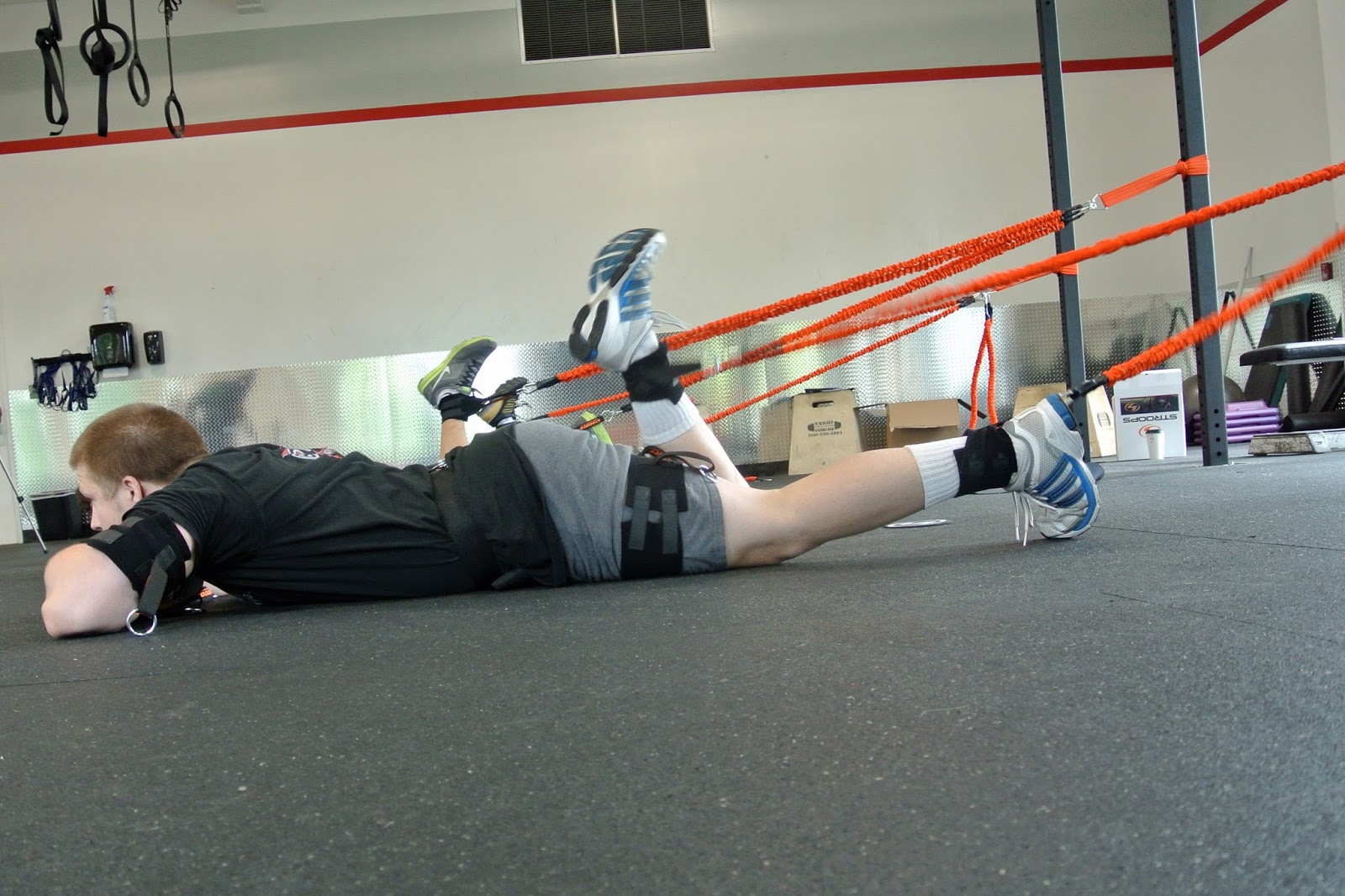
In late August, I attended training conducted by Stroops and purchased two of their SFP kits.  Their SFP (Stroops Functional Performance) kits are this:  cuffs that go around the ankles, wrists, biceps, and thighs, that are then attached to elastic bands.  You can hook up anywhere from two to eight cuffs at a time, and anywhere from one to eight bands at a time.

Why would you do this?!?

Well, the CrossCore (one of my top two favorite pieces of equipment, ever, the second being ViPR) has a different type of resistance than the Stroops equipment, which make them complementary.  With the CrossCore, the ropes are static so the amount of tension on an exercise is constant.  An elastic band like the Stroops fabric-covered "slastics" changes tension as you move deeper into the exercise.  And, the springy properties of the slastics allow for some smooth movements that aren't possible with the CrossCore.


Notice the cuffs that attach to our trainers' wrists and ankles.  I don't have enough right now for our entire small-group class, but I will be purchasing more within the next week to ten days so we can incorporate the training into our sessions.

You will sweat underneath the cuffs.  A lot.  They're neoprene, kind of like wet-suit material.

Options for my clients:

(a)   Use my cuffs, which I allow to dry between sessions.
(b)   Wear sweat-collecting wrist-bands and high socks, and use my cuffs.  This way, you have a washable barrier (the wrist band) between someone else's previous sweat and your skin.
(c)   Purchase your own cuffs  You need at least two, but four is better so you don't have to move them back and forth from wrists to ankles to wrists to ankles.  They are $12 each, plus shipping.  I'll figure out the shipping once I figure out how many cuffs I'm buying and then will divide the shipping between purchasers.

Is it worth buying your own cuffs?  Consider this. We will be using this equipment a week on, a week off, a week on, a week off, for at least the next 6 months and probably longer.  I envision this fitness tool integrating into our class in a similar manner to the way we rotate in the Havyks and the ViPRs.  You are not required to purchase anything.  You are free to use my equipment.  But if you prefer not to share equipment that gets sweaty, I'm providing you with options.  You can facebook me, or email me.


Tuesday, August 27, 2013

Zumba(r) Fitness. Still think it's a fad?


Even though Zumba(r) Fitness has been around for 12 years, I still hear people say, "Oh, it's just a fad."  If you had listened to me five years ago, you would have heard me say the same thing.  My mind has changed significantly on this topic!  Now, I teach three Zumba(r) Fitness formats and they're my highest attended classes of any format I've ever taught in 22 years of fitness (certified or licensed in >15 formats).

Check this chart, though, if you still think Zumba(r) Fitness is a fad.  It's a marketing slide that goes from product awareness to product loyalty.  It was presented by CEO Alberto Perlman at the Zumba (r) Fitness convention opening address, 2013.  Photo taken by me, altered only to straighten horizon and add the source at the bottom.

1)  Product Awareness - what percentage of the public is aware of your brand.
2)  Consideration - of those who are aware of the brand, what percentage are interested in trying it
3)  Trial - what percentage of the aware market has actually tried your product
4)  Loyalty / advocacy / retention.  After trying it,what percentage of people actually stick with the product?

All of the segments on the chart are interesting - 91% of people have heard of Zumba(r)?!?  Wow!!!  That's step 1!  If no one has heard of a product, it's pretty hard to get them to come to your classes.  :D  And of the people offered a chance to try it, half do at some point.  Those are great odds!  Well better than any other format I teach.  Heck, half of the instructors I know have no idea what the formats are that I teach or the products I use (I do some niche stuff), so for 91% of customers to be aware of Zumba(r) Fitness, that's HUGE!  The higher this number, the more people have the opportunity to flow into our classes.  

The segment I find the most compelling is the bottom stripe - loyalty.  The number inside the teal circle - 30%, is the retention rate for Zumba(r) class students.  Nearly 1/3 of the people who try a Zumba(r) class stick with it.  That's crazy-good retention.  The number in the black is the retention rate for the fitness industry - ahem - 7%.  No wonder people are getting as many and more results as some of the "intense" formats out there.  It's really quite simple.  People are sticking to a fitness regime rather than dropping out.

I won't debate with you on whether you like or enjoy Zumba(r) classes; they're not for everyone.  2/3 of the people who try it don't stay.  But I stand my ground, based on the fact that Zumba's retention rate is more than 4 times the average client retention rate in our industry, that Zumba is not a fad.  It has become integrated into fitness, into music, into pop culture, and its effects on multiple industries have changed them for good.

As a fitness professional, I'm going to take a closer look at that chart and apply it to my other formats to see what areas I can improve upon in order to generate business.  For example, my retention in some formats is very high (higher even than Zumba(r)!), but the awareness is low.  So even if you're not a fan of Zumba(r) Fitness, I may have given you something of value by sharing a marketing measurement tool with you.